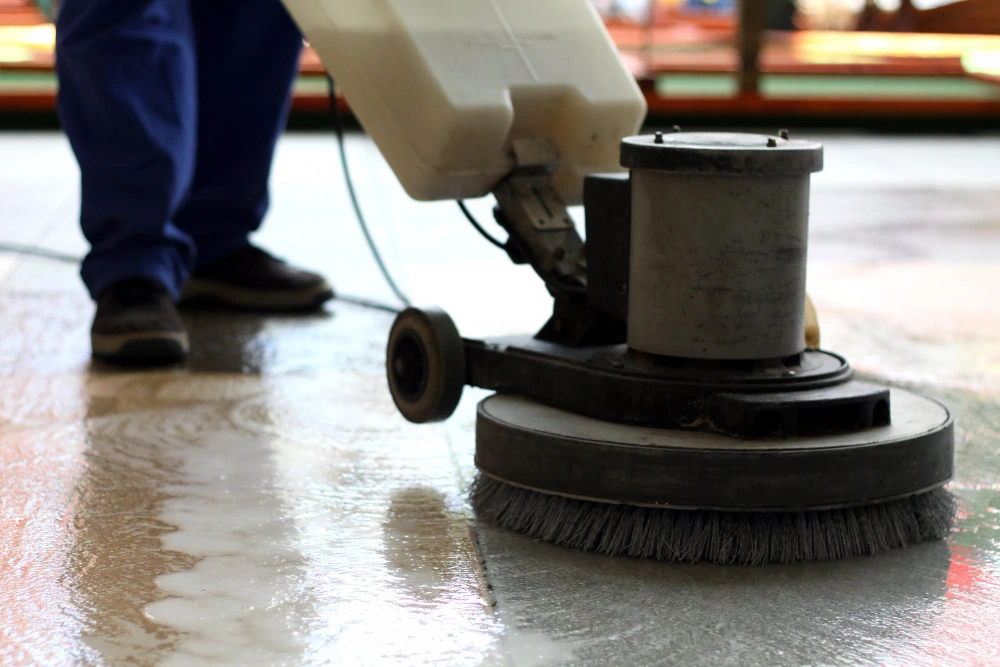
Commercial floors work hard.
Every day, employees, customers, guests, deliveries and equipment can move across the same surfaces. Over time, even regularly cleaned floors can begin to show signs of wear, including scuffs, dullness, staining and built-up grime.
Routine cleaning is essential, but eventually some floors may require more than another clean.
That’s where commercial floor restoration comes in.
Floor restoration is designed to address worn or tired-looking flooring and help bring back a cleaner, more professional appearance. Combined with an ongoing maintenance programme, it can help businesses get more from their existing floors.
At Rise & Shine Property Services, we provide professional floor cleaning, care and restoration services across Auckland, Christchurch, Wellington and Queenstown.
This guide explains the difference between cleaning and restoration, signs that your floors may need attention and how professional maintenance can help keep commercial floors looking their best.
What Is Commercial Floor Restoration?
Commercial floor restoration is a deeper floor-care process intended to improve the condition and appearance of suitable flooring.
The exact process depends on the type of floor and its current condition.
Depending on the surface, restoration may involve:
- Deep cleaning
- Removing accumulated build-up
- Stripping an existing finish where appropriate
- Treating marks and worn areas
- Polishing
- Applying an appropriate floor finish
- Establishing an ongoing maintenance programme
The objective is not simply to clean today’s dirt.
It is to address the condition of the floor itself and improve its overall presentation where possible.
Floor Cleaning vs Floor Restoration: What’s the Difference?
These terms can sometimes be confused, but they serve different purposes.
Routine Floor Cleaning
Routine cleaning focuses on maintaining the floor from day to day.
This may include:
- Vacuuming
- Mopping
- Removing surface dirt
- Cleaning spills
- Mechanical floor scrubbing
- Maintaining general presentation
Floor Restoration
Restoration is generally required when routine cleaning is no longer enough to achieve the desired appearance.
It may involve deeper processes to address:
- Heavy build-up
- Dull finishes
- Scuffing
- Worn appearance
- Existing floor finishes
- Areas affected by significant traffic
In simple terms:
Cleaning maintains the floor. Restoration helps refresh it when maintenance alone is no longer achieving the required result.
Signs Your Commercial Floor May Need Restoration
Floors don’t always need to be visibly damaged before restoration should be considered.
Common signs include:
- Persistent dullness
- Heavy scuff marks
- Uneven appearance
- Embedded grime
- Worn high-traffic areas
- A tired-looking floor finish
- Marks that routine cleaning no longer addresses
- A floor that looks dirty shortly after being cleaned
If routine cleaning is being performed correctly but the floor still looks worn, the issue may be the condition of the surface or finish rather than everyday dirt.
A professional assessment can help determine whether deep cleaning, restoration or another floor-care method is appropriate.
Why High-Traffic Areas Wear Faster
Not every part of a commercial floor experiences the same level of use.
Entrances, corridors, reception areas, lift areas and other common spaces often receive significantly more traffic than private offices or less frequently used rooms.
Over time, these high-use areas may develop:
- Scuffs
- Dirt build-up
- Loss of shine
- Uneven finishes
- Visible traffic patterns
This is why a commercial floor-maintenance programme should consider how the building is actually used, rather than treating every area exactly the same.
Which Commercial Floors Can Be Restored?
The appropriate restoration method depends entirely on the flooring material.
Different commercial properties may contain:
- Vinyl flooring
- Polished floors
- Tile
- Concrete
- Resilient flooring
- Other hard-floor surfaces
Not every floor should be stripped, polished or treated with the same equipment.
Before restoration begins, the flooring should be assessed to determine its material, condition and existing finish.
Professional floor care is about selecting the right process for the floor, rather than forcing one restoration method onto every surface.
Step 1: Assessing the Floor
A good restoration process begins with an assessment.
Before deciding what needs to be done, cleaners should consider:
- Flooring material
- Existing finish
- Overall condition
- Level of wear
- High-traffic areas
- Stains and marks
- Previous floor treatments
- Business operating requirements
This helps determine whether the floor needs routine cleaning, deep cleaning, polishing, restoration or another treatment.
Step 2: Deep Cleaning and Preparation
Restoration generally requires the floor to be thoroughly prepared.
Surface dirt, dust and other build-up need to be addressed before additional restoration work takes place.
Depending on the floor, professional equipment may be used to provide mechanical scrubbing and help remove accumulated grime.
Preparation matters because restoration work should not simply cover over an inadequately cleaned surface.
Step 3: Stripping Existing Floor Finishes Where Required
Some floors have an existing finish or coating that can become worn over time.
Where appropriate for the flooring system, a restoration process may involve stripping an old finish before a new treatment is applied.
This is a specialist process.
The products, equipment and technique need to be appropriate for the floor being treated.
Incorrect stripping methods can potentially affect the flooring, which is one reason commercial floor restoration is best approached professionally.
Step 4: Polishing and Refinishing
Depending on the floor type, polishing or refinishing may form part of the restoration process.
This can help improve the appearance of a floor that has become dull or tired-looking.
The aim is to create a more consistent, well-maintained finish appropriate for the commercial environment.
For businesses where presentation matters—such as hotels, corporate offices and premium hospitality venues—the condition of the floor can have a significant impact on the overall appearance of the property.
Professional Equipment Makes a Difference
Commercial floor areas can be large, heavily used and difficult to maintain using basic cleaning equipment alone.
Professional floor-care equipment allows trained cleaners to tackle suitable surfaces more efficiently and consistently.
At Rise & Shine, one piece of equipment used as part of our professional floor-care approach is Ecoswift’s I-Mop floor scrubbing machine.
The I-Mop combines mechanical scrubbing with efficient water recovery, helping thoroughly clean suitable hard-floor surfaces while leaving them drier more quickly.
Its manoeuvrable design also allows cleaning in tighter and high-traffic areas.
Where Does the I-Mop Fit Into Floor Restoration?
The I-Mop is a floor-scrubbing machine rather than a complete restoration solution on its own.
This distinction is important.
Mechanical scrubbing can form part of:
- Routine floor maintenance
- Deep cleaning
- Preparation
- Ongoing care after restoration
For floors that require stripping, polishing, refinishing or another specialist restoration treatment, additional equipment and processes may be necessary.
The I-Mop therefore forms part of a wider professional floor-care system rather than replacing the restoration process.
Why Water Recovery Matters
Traditional wet mopping can leave considerable moisture on a floor while it dries.
In a busy commercial environment, this can cause disruption and create additional slip considerations.
The I-Mop’s water-recovery system helps recover used water during the cleaning process, allowing suitable hard floors to dry more quickly.
This can be particularly useful in environments that need cleaning carried out efficiently around normal operations.
Floor Restoration in Hospitality Environments
Hotels, bars and other hospitality venues can experience intensive foot traffic.
At the same time, these businesses often have high expectations around presentation.
Guests may notice:
- Dull floors
- Scuff marks
- Dirty entrances
- Worn traffic areas
- Inconsistent finishes
A structured floor-care programme can combine routine cleaning, mechanical scrubbing and periodic restoration to help maintain the overall presentation of the venue.
This is particularly valuable in premium hospitality environments where floors form a visible part of the guest experience.
Floor Restoration for Corporate Offices
Corporate environments also depend heavily on presentation.
Reception areas, entrances, corridors and meeting spaces can contribute to a visitor’s first impression of a business.
Even when the rest of an office is clean, heavily worn flooring can make the environment feel less maintained.
Professional floor restoration can help refresh suitable floors, while an ongoing maintenance programme helps protect the restored appearance.
Floor Care in Healthcare and Education Facilities
Healthcare and education environments often contain large floor areas with significant daily foot traffic.
In these settings, floor care needs to consider both cleanliness and safe working procedures.
Routine floor cleaning can be combined with periodic deep cleaning and restoration where appropriate.
The method selected should always suit the flooring material and the operational requirements of the facility.
Cleaning Chemicals and Professional Floor Care
Professional floor care involves more than using machinery.
The cleaning products used also need to be appropriate for the surface and task.
At Rise & Shine, our cleaning processes are supported by eco-conscious, hospital-grade cleaning chemicals where appropriate.
Products are used as part of a defined cleaning process rather than simply being applied without consideration for the surface.
The correct combination of equipment, cleaning solution, technique and trained staff helps create a more controlled floor-care process.
Health & Safety During Floor Cleaning
Floor cleaning and restoration can involve wet surfaces, machinery, chemicals and battery-powered equipment.
Health and safety therefore needs to form part of the process.
Rise & Shine’s battery-powered equipment is inspected before use to confirm that relevant components, including the vacuum, battery, filters and attachments, are in safe working condition.
Charging is carried out using approved chargers in suitable locations away from ignition sources, excessive heat and combustible materials.
Wet-floor risks also need to be managed appropriately while cleaning or restoration work is underway.
What Happens After a Floor Is Restored?
Restoration should not be viewed as the end of floor care.
Without appropriate maintenance, a restored floor can gradually return to a worn condition.
A maintenance programme may include:
- Regular removal of surface dirt
- Appropriate mopping
- Mechanical scrubbing
- Prompt cleaning of spills
- Monitoring high-traffic areas
- Periodic deep cleaning
- Additional polishing or restoration when required
The right programme depends on the floor and how the building is used.
How Often Does Commercial Floor Restoration Need to Be Done?
There is no fixed restoration schedule that applies to every business.
Frequency depends on factors including:
- Flooring type
- Foot traffic
- Type of business
- Existing floor finish
- Quality of routine maintenance
- Exposure to dirt and moisture
- Presentation requirements
A busy hospitality entrance may require a different maintenance cycle from a low-traffic office.
Rather than restoring according to a generic timetable, businesses should monitor the floor’s condition and arrange professional assessment when routine cleaning is no longer producing the desired result.
Can Regular Maintenance Reduce the Need for Restoration?
A well-planned maintenance programme can help floors remain presentable for longer between major restoration work.
Routine removal of dirt and prompt attention to spills can help prevent unnecessary build-up.
Mechanical floor cleaning can also provide a deeper clean for suitable hard floors than basic mopping alone.
This creates a simple floor-care cycle:
Routine Cleaning → Mechanical Scrubbing → Periodic Deep Cleaning → Restoration When Required → Ongoing Maintenance
The goal is to avoid waiting until the floor is heavily worn before giving it attention.
Choosing a Commercial Floor Restoration Company
Before selecting a provider, consider asking a few important questions.
Do They Assess the Floor First?
The restoration method should be based on the flooring material and condition.
Do They Have Professional Floor-Care Equipment?
Commercial flooring may require specialist machinery rather than basic cleaning equipment.
Can They Provide Ongoing Maintenance?
Restoration works best when followed by appropriate routine care.
Are Their Employees Trained?
Equipment and cleaning products need to be used correctly.
Do They Follow Health & Safety Procedures?
Commercial floor restoration involves machinery, chemicals and potentially wet surfaces, making appropriate safety procedures essential.
Can They Work Around Your Operations?
For offices, hospitality venues and other businesses, scheduling can be important for minimising disruption.
Commercial Floor Restoration Across Auckland, Christchurch, Wellington and Queenstown
Different commercial properties have different floors, traffic levels and presentation requirements.
Rise & Shine Property Services provides professional floor care across:
Auckland | Christchurch | Wellington | Queenstown
Our approach brings together professional equipment, trained cleaners, appropriate cleaning products and structured procedures to help businesses maintain their commercial floors.
From routine floor cleaning and mechanical scrubbing to deeper floor-care and restoration requirements, the objective is always to choose the right process for the surface.
Give Worn Commercial Floors a Fresh Start
A worn-looking floor doesn’t always need to be replaced.
Depending on its material and condition, professional restoration may help refresh its appearance and bring it back to a more presentable standard.
More importantly, restoration should be supported by an ongoing maintenance programme designed around the floor and the way the property is used.
At Rise & Shine Property Services, we provide professional commercial floor care across Auckland, Christchurch, Wellington and Queenstown.
If your commercial floors are looking dull, heavily marked or difficult to maintain through routine cleaning alone, contact Rise & Shine Property Services on 0800 274 469 to discuss your floor-care requirements.
Restore the finish. Maintain the standard. Keep your business looking its best.